Medication errors are systemic failures, so Safer-Med is a systematic safeguard: a
patient-specific re-check at the moment a dose leaves the automated dispensing
cabinet. It listens to the events your EMR and cabinets already emit, evaluates each
dispense and override against the patient as they are now, stays quiet unless
something has changed, and routes what matters to the nurse holding the dose —
with pharmacy in the loop.
Safer-Med receives the orders, labs, vitals, allergies and diagnoses your EMR already sends, and the dispense and override events your cabinets already emit, over standard HL7 v2 and FHIR R4 interfaces. It never writes to the EMR and never controls the cabinet.
Evaluate — against the patient as they are now
When a dose is pulled, personalized clinical rules weigh that medication against the patient’s current labs, vitals, diagnoses, weight, age and active therapy. On an override, a targeted AI check also asks one narrow question: does this medication look like a wrong-drug or wrong-patient selection?
Filter — only what is new and meaningful
A routine dispense alerts only when the risk is new since the pharmacist verified the order. Missing data is never a finding, intended drug pairings are recognized, and a finding the nurse has already reviewed doesn’t repeat while nothing has changed.
Reach the nurse holding the dose
The finding goes to the dispensing nurse on the clinical-communications app the unit already uses: who, what, what changed, and why it matters now. The nurse reviews it and decides — proceed, call pharmacy, or hold — within scope of practice and hospital policy.
Close the loop with pharmacy
Pharmacy sees the same finding, its reason and the nurse’s response on a review dashboard, and an unanswered high-risk finding escalates. Every step is recorded in an append-only audit trail for medication-safety governance.
Under the hood
Read-only in. Notification-only out.
Safer-Med runs in a single-tenant environment dedicated to your organization, between
the systems you already run. Specific interfaces, fields and routing are confirmed
against your environment during setup.
Hospital systems · read-only in
EMR (e.g. Epic)
Orders, labs, vitals, allergies, problems, admissions — HL7 v2 pushed by your interface engine; FHIR R4 pull for what the feed doesn’t carry.
Dispensing cabinets
Pyxis or Omnicell dispense and override events — the trigger for every check. No hardware or firmware change.
→
Safer-Med · single-tenant, encrypted
1 · Patient record
Every feed correlated to one live patient timeline: active orders, recent results, infusions, dispenses and administrations.
2a · Clinical rule engine
Personalized rules on every dispense and override, plus your site rules — versioned, with rollback.
2b · AI override check
Overrides only: a likely wrong-drug or wrong-patient selection. Runs in-environment, under BAA.
3 · Alert lifecycle
New-since-approval filter, repeat suppression, escalation, and shadow or live delivery — by alert type, audience and unit.
4 · Audit trail
Append-only record of every finding, delivery and response.
→
Clinicians · notification-only out
Dispensing nurse
Through your clinical-communications platform — e.g. Epic Secure Chat, TigerConnect or Mobile Heartbeat. One-tap response returns on a signed callback.
Pharmacist
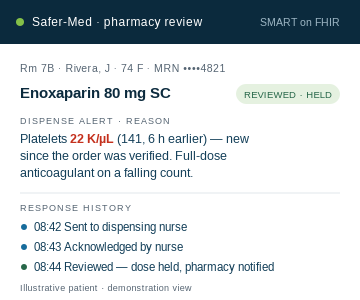
A review dashboard embedded in the EMR via SMART on FHIR: the finding, its reason and the nurse’s response.
Never writes to the EMR · never controls the cabinet · if Safer-Med is
unavailable, the existing dispense workflow is unaffected
Two mechanisms
Clinical rules on every pull. AI only where it helps.
Personalized clinical rules · every dispense and override
The order was right. The patient changed.
Explainable, sourced rules re-assess medication risk against the patient’s evolving picture — for example, a full-dose anticoagulant on a platelet count that fell overnight, or a renally cleared drug as kidney function declines.
Changing labs, vitals and organ function, with recency
Active orders, recent dispenses and continuous infusions
Interactions, duplicate therapy and combination dose limits
What changed since the order was verified
Targeted AI · overrides only
The wrong medication may have been selected.
An override releases a drug before any pharmacist review. The AI weighs the medication actually pulled against the patient — diagnoses, age, allergies, active therapy, labs — and what is typical on the unit, to flag a likely wrong-drug or wrong-patient selection.
One narrow conclusion: please verify the medication and patient
Never judges clinical appropriateness or recommends treatment
Weighs the medication against the patient — never the nurse
What clinicians see
One finding. Two connected clinical teams.
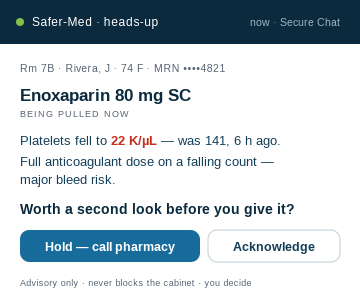
Nurse · a second look, on the phone they already carryPharmacy · the same finding, its reason and the documented response
Illustrative patient · demonstration environment. Fields, wording and response
options are validated with your own pharmacy and nursing teams before go-live.
Alert burden
Every alert must earn its interruption.
A safety net only works if nurses trust it. Safer-Med does not repeat the checks already
done at prescribing and verification — it looks for what has changed since, or what
was never reviewed, and filters out the situations that generate noise.
Fewer alerts
Only what changed since approval
A routine dispense alerts only if the risk is new since the pharmacist verified the order — a new lab result, allergy or diagnosis. Overrides, never verified, get the full check.
Already approved with the condition known
No drug–disease or allergy alert when the same drug was already ordered and verified after that lasting diagnosis or allergy was documented.
No repeats after review
Once the nurse has reviewed a finding, it stays quiet on later pulls of that order while nothing changes — and returns as a new alert only if the condition clears and recurs.
Measured, not assumed
Kidney, liver, blood-count and blood-pressure conditions are judged from current results, with recency — not from an old diagnosis code. Missing data is never a finding.
Drug pairs need real overlap
No interaction or duplicate-therapy alert when neither drug is scheduled, and intended pairings — such as a standard anticoagulant bridge while the INR is still low — are recognized.
The intended dose isn’t an error
On an override of a drug the patient already has a verified order for, interaction, duplicate and allergy checks are skipped — the override is the intended dose.
Local preparations stay out
Eye, ear and skin preparations and heparin line flushes take no part in interaction alerts.
Serious findings only
Major and contraindicated findings are delivered; moderate and minor are not.
Actionable when it fires
Specific
The reason, with the numbers
Each finding names the medication, what changed and when — “platelets 22, down from 141 six hours ago” — and why it matters now, with its clinical source. No generic warning text.
Right person, right moment
To the nurse holding the dose
Routed to the nurse who just pulled the medication, after the pull and before administration — on the device they already carry. The lock-screen line carries no patient identifiers; the detail opens in context.
One-tap response
A clear next step
Acknowledge, or call pharmacy, in one tap. The response returns to Safer-Med and the pharmacist, and an unanswered high-risk finding escalates through your communications platform.
Closed loop
Pharmacy sees the same finding
The pharmacist works the same finding, reason and nurse response on a review dashboard — overrides prioritized so attention goes where it matters.
Tunable
Your thresholds, your units
Alert categories are set separately for dispenses and overrides, and every type can run silently or live, per audience and per unit. Site rules for local policy are written in plain language and versioned.
Evidence before activation
Measured in shadow mode
Every finding is recorded from day one. Before any nurse is paged, pharmacy and nursing review the would-have-fired stream — alerts per 1,000 dispenses and per nurse per shift — and activate on evidence, unit by unit.
How it’s tested
Verified as software and as clinical logic.
Before it meets a partner’s live data, the product is tested end to end —
and every release of its clinical logic is versioned and reviewable.
Clinical rule testing
Should-fire and should-not-fire scenarios
Clinical rules are exercised by automated scenarios on both sides of their conditions — the patient for whom a rule must alert, and the near-identical patient for whom it must stay quiet: a lab that is too old, an intended drug pairing, a condition already known at verification.
Historical replay
Run against real, de-identified clinical data
The engine is replayed end to end over de-identified hospital records — orders, labs, vitals and administration events in time order — and changes to the clinical logic are re-run and their alerts compared with the previous version before release.
Reproducibility
Versioned clinical logic, exact rollback
Each rule-set release is an immutable, versioned snapshot, so the same data under the same version yields the same findings, any change can be reviewed as a diff, and a release can be rolled back exactly.
Clinical relevance, alert burden and incremental value are then measured with each
development partner, on its own data, in the
three-phase evaluation.
Next step
See what it would surface on your own data.
A development partnership begins with a retrospective on your historical data, moves
to shadow mode on live feeds, and reaches graded go-live only by mutual agreement.
Pharmacy, nursing and informatics shape it together — see the view for
pharmacy,
nursing or
informatics.